When symphonies collide: Mäkelä returns to CSO with sterling Sibelius and discordant Shostakovich
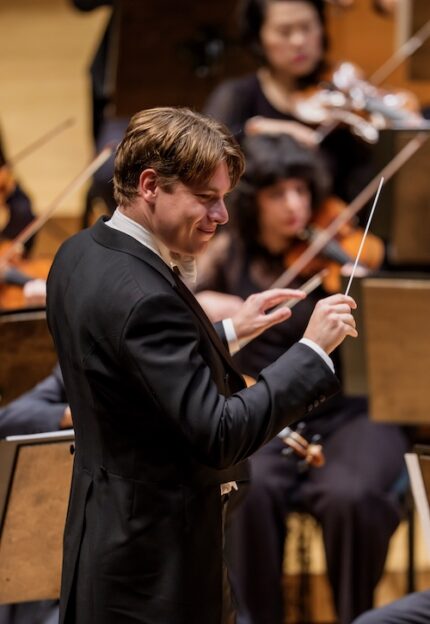
For the first program of his three-week fall residency with the Chicago Symphony Orchestra, Klaus Mäkelä is pairing one of the most concise and perfectly wrought symphonies in the repertoire with one of the most sprawling and, well, imperfect.
The evening led off with the Symphony No. 7 by Jean Sibelius, the last and, for many, the greatest of the Finnish composer’s works in the genre. From the romantic, Russian influence of his first two symphonies, Sibelius increasingly toiled toward a greater brevity of form and concentration of material. His efforts found their apotheosis in the Seventh, cast in a single extraordinary movement of 22 minutes.
While he has led shorter Sibelius works with the CSO and a powerful performance of the composer’s Lemminkäinen last February, this week’s concerts mark Mäkelä’s first, highly anticipated, local performance of a symphony by his great compatriot.
Mäkelä’s debut recording was nothing less than a complete set of Sibelius symphonies with the Oslo Philharmonic, recorded under stringent Covid conditions. Fine as that Oslo Seventh was, the Finnish conductor led the CSO in an even more boldly projected performance Thursday night with rich, full-bodied textures and incisive drama. The Seventh retools traditional symphonic form in an atomized fashion, and each passing section flowed logically into the next, with the shifting character vividly registered, as with the buoyant lift of the playful scherzo.
As is so often the case with the CSO’s music director designate, not a bar felt routine under Mäkelä’s organic, focused direction. Balancing was most impressive with each strand of Sibelius’s complex polyphony audible in an unusually impactful way. The performance’s momentum traced a firm through-line in this work, culminating in a coda invested with cumulative weight and dramatic inevitability.
Tim Higgins was first among equals in this performance, the CSO’s principal trombonist imbuing the main motif with noble gravitas—and a nice trace of asperity—rising to his majestic final statement.
The only minor disappointment was that none of the woodwind principals were on stage for this work. (In fairness, they had plenty of heavy lifting to do in the Shostakovich after intermission.) While the wind playing was polished and responsive, there was a fitful bland efficiency, and one would have liked greater character in the playing to match that of the brass and strings.
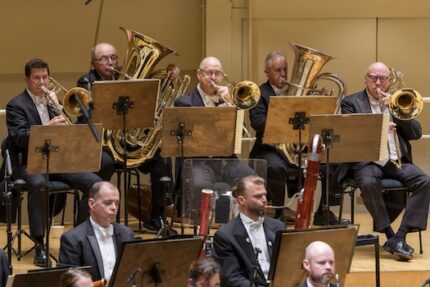
Photo: Todd Rosenberg
Not much more than a decade separates the Sibelius Seventh from Dmitri Shostakovich’s Symphony No. 4 in chronology but in style and scale the two works are galaxies apart.
Shostakovich famously withdrew the symphony before its scheduled 1936 premiere—likely under pressure from the Soviet cultural commissars—and the work was not heard until 25 years later, when it was debuted by Kirill Kondrashin and the Moscow Philharmonic in 1961.
If the Sibelius Seventh is a masterpiece of taut concision, Shostakovich’s Symphony No. 4 is the polar opposite—a wild, cacophonous ride, scored for the largest forces the composer ever employed (eight horns, four flutes and as many clarinets, oboes and trumpets).The work spans an hour, with two massive movements framing a shorter middle section. The scale is huge with violent, roiling contrasts throughout in every possible way—dynamics, instrumentation, tempos, and material.
Shostakovich was greatly influenced by Mahler, and never more conspicuously than in the Fourth Symphony with the seismic bursts and contrasts dialed up to 11. One gets the sense of the young composer pushing the boundaries of what is acceptable within symphonic form—the musical equivalent of stealing Mahler-Dad’s Maserati and taking it for a spin at top speeds while trying to avoid crashing and burning.
And yet, for all its individuality, harmonic ingenuity and whirlwind audacity, one can’t say that the Fourth stands among Shostakovich’s finest works in the genre (namely Nos. 5 and 11, as well as 8 and 10). The excesses seem self-conscious and the lack of structural unity and a coherent musical narrative ultimately make the symphony feel like less than the sum of its often-deafening parts.
That said, one is unlikely to ever encounter a performance of such high voltage and astounding intensity as that unleashed by Mäkelä and the CSO musicians Thursday night.
The conductor clearly believes in this work (he has recorded Shostakovich’s Fourth Symphony in a set with the Fifth and Sixth), and he drew playing of demonic fury and crackling virtuosity from the musicians throughout. Mäkelä kept this demanding Leviathan on track with laser-like focus—from the opening malign march that segues into cheeky, satiric music to the discordant, cochlea-jangling climaxes and the final section, where uneasy solos by horn, flute, violin and celesta provide an ambivalent coda.
Rarely will one experience all sections of the CSO playing with the kind of unbridled intensity that characterized the most crazed pages Thursday night. Among the many individual highlights were Tim Higgins’ trombone work (again) and principal bassoon Keith Buncke’s loping solo that opens the final movement.
____________
A new branding puts the “C” in CSO
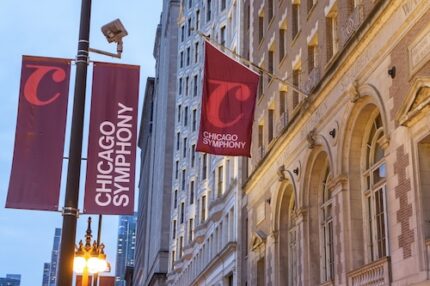
The CSO is doing some major rebranding this week timed to Mäkelä’s return.
The orchestra unveiled its new logo Thursday—a single letter “C”— marking its first design change in 30 years. Also the cumbersomely titled Chicago Symphony Orchestra Association will henceforth be known simply as “Chicago Symphony.” (The orchestra itself retains its full title of Chicago Symphony Orchestra.)
Likely more germane for concertgoers is that the CSO website has been changed from cso.org to chicagosymphony.org. Those going online to the old URL are automatically forwarded to the new one.
Whatever one may think of the visual esthetics, give credit to the organization for making the switch in a big and uniform way. The new logo was everywhere Thursday night—from concert programs to the foyer carpeting, ushers’ name tags and merch in the CSO shop with coffee mugs, water bottles, t-shirts and pens all emblazoned with the new CSO “C”.
The program will be repeated 7:30 p.m. Saturday. chicagosymphony.org

