20th-century works highlight a weekend at the Marlboro Festival
For seven weeks each summer, the Marlboro Music Festival hosts a cohort of rising and established chamber musicians. Under artistic directors Mitsuko Uchida and Jonathan Biss, this cherished institution continues to offer weekend public concerts on the campus formerly occupied by Marlboro College. Lovers of chamber music make the pilgrimage each summer to this quiet place in Vermont’s Green Mountains.
These listeners form an audience that is among the most attentive in the world. The regular chorus of coughing, page rustling, cell phone noises, and the like is almost entirely mute. What might be called the “Marlboro moment,” in which the musicians pause for a significant amount of time to collect their thoughts on stage while the audience settles into silence, marks the beginning of almost every piece.
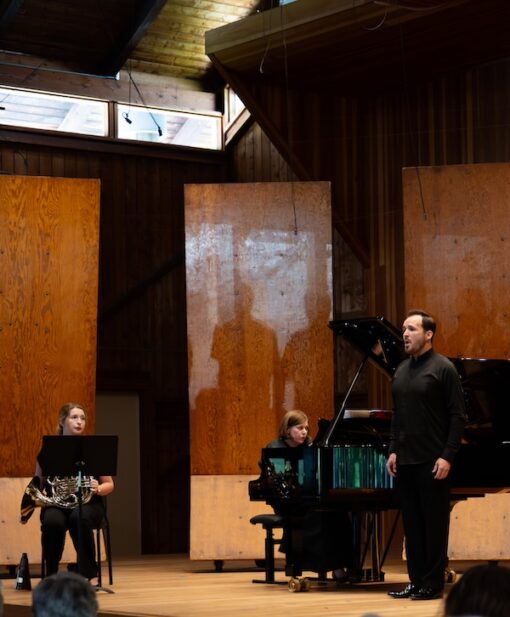
Of the two weekend concerts, Sunday’s program took the prize for a pair of 20th century works. Eric Finbarr Carey, a young rising tenor, delivered a heart-rending performance of Benjamin Britten’s Canticle III: Still falls the Rain, conveying Edith Sitwell’s devastating poetry with a clear tone and excellent diction. The poem, subtitled “The Raids, 1940. Night and Dawn,” draws a connection between the Blitzkrieg and the suffering of Christ on the cross.
Pianist Lydia Brown and horn player Carys Sutherland wove together interludes between Carey’s often unaccompanied verses, with a striking array of sounds. Sutherland displayed impressive control over the instrument’s range, with unsettled colors added by buzzing stopped notes in one martial passage. She then calmly interlaced muted long notes with Carey’s steady voice, both impeccably in tune, near the end. Carey’s loudest sound, often in an unsung growl, brought home the most impassioned passages.
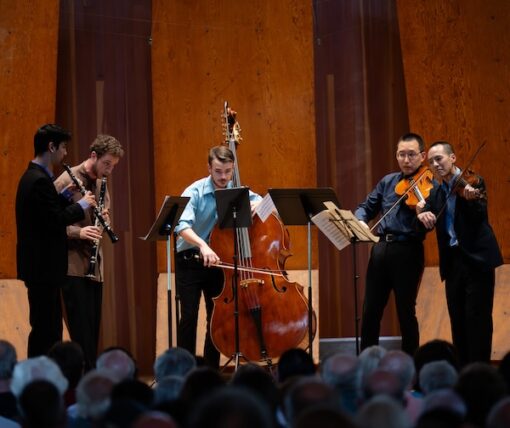
Prokofiev’s Quintet, Op. 39, captivated with another unusual combination of instruments. The composer created this music for a ballet called Trapèze, commissioned by a small dance company that performed with just oboe, clarinet, violin, viola, and double-bass.
Thanks to a balanced ensemble approach, the performers brought the score’s satirical and madcap elements to life with active and vivid clarity. Clarinetist Jonathan Leibovitz added the most agitated sounds, with a braying top range and fleet fingerwork. Oboist Alexander Mayer, with a more demure tone, led a poignant lament in the Adagio pesante movement. Bassist Tobias Vigneau ably took up Prokofiev’s challenge to be more than just a foundational bass line, with a number of charming solos, both serious and comic. Violinist Joseph Lin and violist Jonathan Chu joined Vigneau in some hilarious glissando effects, as well as anchoring the rhythmic drive of the more grotesque movements.
Saturday’s concert stood out for featuring music from the 21st century, with two intriguing pieces by Marcos Balter, this summer’s composer-in-residence. Born in Brazil, Balter now teaches at Columbia and, since last year, co-directs the music composition program at Tanglewood. His piece for string quartet, Chambers (from 2011) opened with a first movement exploring high sounds from violinists Masha Lakisova and Laurel Gagnon, underpinned by fragile insect-like peeping from violist Brian Isaacs and cellist Jay Campbell. Tremolo textures later added a degree of agitation, but overall the movement remained in an ethereal mode.
The other two movements continued this exploration of the sonic outer edges of string instruments, each within its own world, like the three “chambers” of the title. Pizzicato motifs gave the second movement the feel of a serenade initially, with staccato notes like stabs of sound in the middle section. Surf-like sounds, created by bowing on the bridge, punctuated sections. In the longer third movement, Balter made the string quartet sound something like a spectral glass harmonica, with many flute-like harmonics.
The piece succeeded because Balter avoided monotony by never indulging one sound too long. In the other work on the program, Codex Seraphinianus (from 2014), Balter sought a vocabulary of enigmatic ideas. Bassoonist Duncan Henry, flutist Hannah Tassler, clarinet Arthur Stockel, and violist Beth Guterman Chu obliged, with Chu even accompanying her own part by whistling a second line. The piece’s absurdities made for a more contrived result.
Both of this past weekend’s programs featured older music as well. The best such work came on Saturday, with Beethoven’s Clarinet Trio in B-flat Major, Op. 11. Clarinetist Arthur Stockel adroitly handled the explosion of running notes in the first movement, taken at a brilliantly fast tempo. Pianist Ignat Solzhenitsyn, son of the celebrated Soviet writer, introduced moments of calm with the new harmonic world of the second theme, set in a mysterious pianissimo.
Cellist Nagyeom Jang introduced the slow movement’s longing theme with delicacy, answered serenely by the other musicians. Beethoven based the third movement on a “hit tune” (the “Gassenhauer” by which the Trio is sometimes known) from a Joseph Weigl comic opera. Beethoven could weave the humblest thread into something exquisite, as he did here in nine variations, each given an individual touch by the three performers.
String quartets by Schubert and Brahms, Bartók’s Contrasts, and Beethoven’s Piano Trio in B-flat Major will be performed August 1 and 2. marlboromusic.org

