Mäkelä, CSO wrap year with bracing contemporary works, Beethoven and Schumann
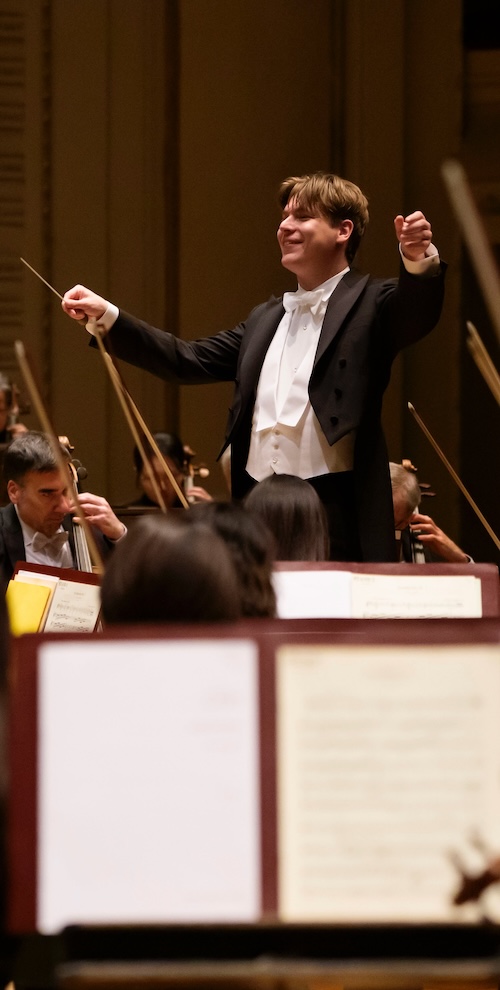
The final Chicago Symphony Orchestra program of 2025 offered much to attract concertgoers: warhorses by Beethoven and Schumann as well as the subscription debut of pianist and Van Cliburn gold medal winner Yunchan Lim.
But, of course, the main ingredient was the return of Klaus Mäkelä, the CSO’s music director designate, whose popularity seems to be growing exponentially with each appearance. Indeed, after sparse attendance for CSO programs all month, Thursday night’s concert drew a rare sold-out house.
And with increasing Chicago appearances and familiarity the Finnish conductor seems to be winning over his naysayers. “I’m becoming a believer,” said one Mäkelä skeptic, a regular CSO attendee, on his way out of Orchestra Hall.
For many, the most encouraging aspect of Thursday’s concert was not just the outstanding quality of the performances but the fact that Mäkelä slated not one, but two contemporary works for the evening. With pianist Lim’s generous encore, that edged the concert past the two-hour mark but on this occasion, nobody was complaining or leaving early.
The evening also displayed the conductor’s intelligent approach to programming with the concluding Beethoven Symphony No. 7 prefaced by a pair of 21st-century works inspired by the composer, each a CSO premiere.
Unsuk Chin’s subito con forza opened the evening in bracing fashion. The work kicks off with the opening chord from Beethoven’s Coriolan Overture but the instant ensuing clamor of rattling metallic percussion tells us we’re not in Bonn anymore.
Beethoven often utilized the marking subito con forza (suddenly, with force) in his scores and that description surely applies to Chin’s restless score. The South Korean composer packs an astounding amount of musical activity into five minutes: flitting fragments of Beethoven’s Fifth Symphony and piano roulades from the Emperor concerto leap out amid motoric riffs, strident brass bursts, slapped double bass chords, tolling chimes, and colorful bursts of marimba and xylophone solos, part of the Brobdingnagian percussion battery.
Mäkelä conducted the world premiere of subito con forza in 2020 and he drew a notably well-balanced performance from the CSO musicians, who gave blazing advocacy to Chin’s kaleidoscopic score. (One can see and hear Mäkelä’s performance of the work with the Oslo Philharmonic here.)
Jörg Widmann’s Con brio, written in 2008, presents a more expansive canvas at 12 minutes. Unlike Chin, the German composer/clarinetist/conductor uses no literal Beethoven quotations or percussion, apart from the timpani.
The boisterous cacophony of Con brio is like encountering isolated Beethoven-like fragments in rapid-fire succession through a distorted lens. But primarily Widmann’s work is imbued with Beethovenian spirit—fast-paced and eruptive with a bristling nervous energy, wide timbral contrasts, and antic humor that seems to bring the composer’s subversive musical personality into the 21st century.
Widmann’s score includes six pages of unusual, highly detailed “prepared” instructions, including asking the woodwinds to breathe noteless sounds into their instruments:
“Form the syllables ‘TEE-OO-TOO’ with breath (voicelessly!) (1x light, 2x dark); increase breath resistance through position of lips intensively to permit this “breath action” to sound as loudly and noisily as possible.”
Opportunities for Chicago Symphony players to tackle a demanding modern score with this kind of density and complexity—and for Chicago audiences to encounter such music—have been all too rare over the past 15 years.
Led by Mäkelä’s animated and inspirational direction, the CSO musicians sounded positively unleashed Thursday night with playing of galvanic fury and surprising intensity that brought Widmann’s symphonic heavy metal to spellbinding life. Kudos to all, especially timpanist Vadim Karpinos for his turn as rock drummer on the sides on the kettledrums. Let us hope that Mäkelä continues to bring equally challenging and rewarding new works to Chicago in future seasons.
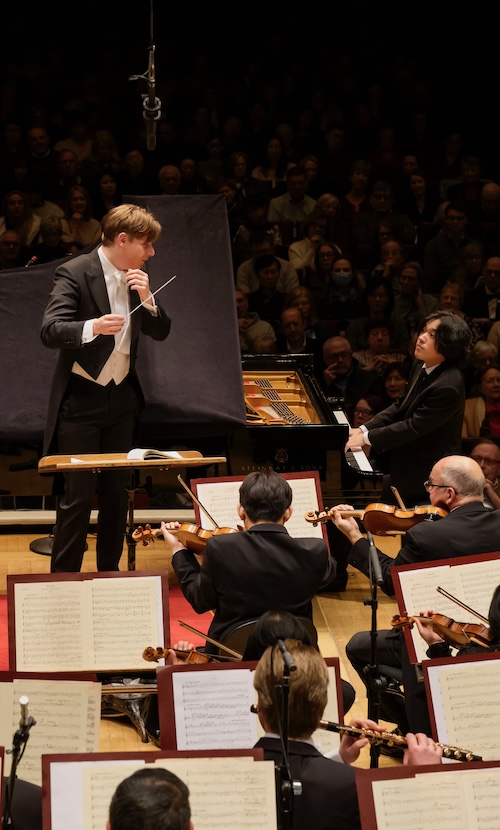
The youngest winner of the Van Cliburn Competition (at age 18 in 2022), pianist Yunchan Lim largely lived up to his advance billing in Schumann’s Piano Concerto. His technique is faultless and he was fully in synch with the fantasy element of the concerto, blending easy virtuosity in the outer movements with a reflective intimacy that suited Schumann’s pensive moments especially well. In the buoyant finale there was an alarming moment when Lim and the orchestra went in different directions, but conductor and soloist quickly got back on the same page.
With all the rehearsal time required for the Chin and Widmann works, one wondered if the orchestral part would suffer in the concerto, which usually happens in these instances. Far from it. Mäkelä led a focused and richly detailed account that had one marveling at details in Schumann’s scoring that usually go unheard. Not a single bar of his accompaniment sounded half-hearted or routine.
Lim responded to the ovations with an encore of Chopin’s Waltz No. 3 in A minor, Op. 34, no. 2. Polished and idiomatic as his concerto performance was, Lim’s Chopin was on another level altogether—a spacious, poetic introspection with a nuanced array of dynamic and expressive detailing that made it feel like we were eavesdropping on a private soliloquy.
The evening closed with the real thing—Beethoven’s Symphony No. 7, Mäkelä’s first performance of any of the composer’s music in Chicago.
Coming immediately after Widmann’s roistering sound and fury, one feared even Beethoven might sound like one of Ignaz Pleyel’s lesser works.
Not to worry. In this canonic work, Mäkelä directed a superb and idiomatic Beethoven Seventh, polished and scrupulously balanced, spirited in the framing movements yet without ever losing an essential gracious quality.
The slow introduction in the first movement of the Seventh Symphony was refined and elegant, creating expectancy, with a sense of release at the swing into the Vivace. Mäkelä appeared to take all repeats, giving the symphony its full grand dimension. The Allegretto emerged notably fresh with dynamics closely observed and the dirge-like main theme somber without being portentous. Following a tightly coiled Scherzo, the finale was thrilling, not for souped-up speed or frenzy but more for the polish of the playing and the clarity of the counterpoint.
Guest principal flute Herman van Kogelenberg (principal of the Munich Philharmonic) contributed pure-toned and musicianly playing, blending with the CSO winds like he has been playing with them for years.
Mäkelä’s moulding of the CSO’s corporate sound is coming more clearly into focus with each performance. He seems to prefer a more brilliant, even edgy sonority, one less string-heavy and Viennese than that of Riccardo Muti. The balancing feels more streamlined, with leaner strings and more prominent winds, the conductor letting the brass off the leash to cut loose at key moments. While clearly a work in progress, overall the CSO is sounding and feeling like a more contemporary and flexible ensemble–one befitting a youthful music director in 2025.
With Klaus Mäkelä and the CSO ending the year on a high note, one is looking forward to more happy discoveries in years to come under the orchestra’s charismatic leader in waiting.
The program will be repeated 1:30 p.m. Friday and 7:30 p.m. Saturday. cso.org.

