Sierra and Villazón shine brightly in Met’s new “Sonnambula”
For such a famous opera, a vehicle for some of the great modern divas, La Sonnambula has a surprisingly low profile. Bellini’s bel canto story of young woman who sleepwalks her way into romantic and social crisis is naturally centered on spectacular arias for the soprano lead and her tenor counterpart. But stagings are infrequent, Sonnambula is more heard of than heard. So the new production that opened Monday night at the Metropolitan Opera is a draw simply for existing.
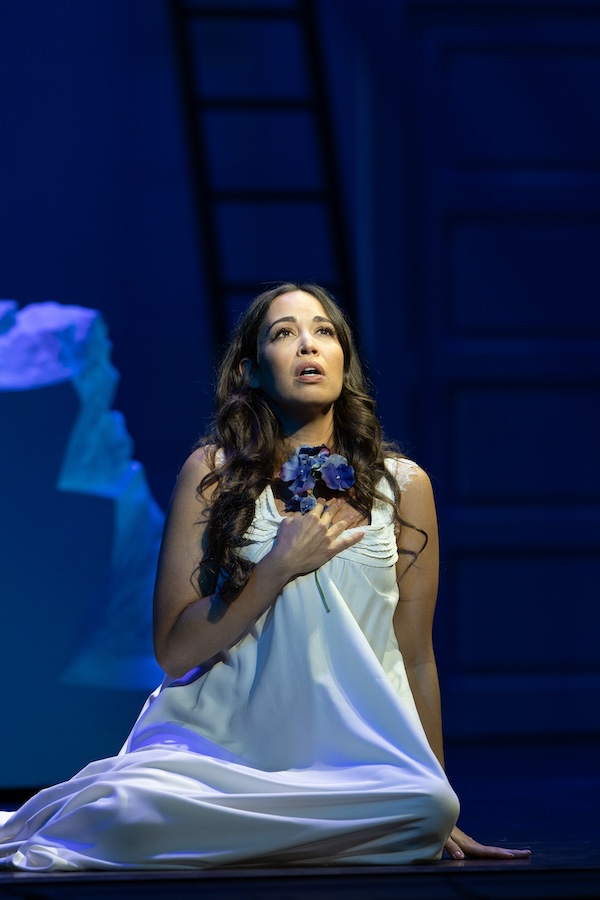
But this new production, the first at the Met of this work since 2014, is vivid and compelling for two other, more substantial reasons. One is to see and hear soprano Nadine Sierra in the bravura role as Amina. The other is to see what opera tenor Rolando Villazón has put on stage for his directorial debut at the Met. And a superb Sierra and brilliant Villazón make a fantastic pair.
Sierra is also paired with the equally outstanding tenor Xabier Anduaga as Amina’s fiancé Elvino. Causing trouble and provoking laughs are soprano Sydney Mancasola as Lisa and bass Alexander Vinogradov as Count Rodolfo. Riccardo Frizzi conducts.
Laughter is the key that this production uses to center what is at the core a dramatically ambivalent opera with an uneven balance between seriousness and comedy, and with drama built on the core of the popular pantomime ballets of the mid-19th century. That means that while the overall score may not be exemplary in its form, from aria to aria there is great characterization and drama. This cast made that substantial and often glorious.
Sierra is one of the leading voices in the opera world, and it was a great pleasure to hear her as Amina. The technique was there in the trills, the range in athletic challenges like “Ah! non giunge uman pensiero” to close the night. More meaningful and important was the sound of her voice, a kind of amber glow that had the clarity of youth and, increasingly, just the right amount of mature richness. That brought out the best in this role, which combines a naïve ingénue with a woman who can accept her world falling apart and keep moving forward.
Above and beyond all this was her musicality. From the start, with “Care compagne,” she was focused on the shape and direction of each vocal phrase, with a light but thoughtful articulation of how she thought things should start and finish. Her dynamics were subtle and even the thrilling high notes had a purpose beyond just spectacle.
If she easily dazzled in Act I, she was moving in Act II, where the music gave her the chance to show off her artistry. Sound, phrasing, technique all melted into the expression of musicality, and even the simplest things like her crescendo to open “Reggimi” were captivating. The extended climactic music of “Oh! Se una volta sola” and “Ah! No credea mirarti,” was beautiful and complex, Sierra singing through a mix of conflicting moods, where she was mesmerizing and moving because of the delicacy and emotional purpose of her artistry. She surpassed the seriousness in the opera, and there was a real sense of fun to her performance that was essential.
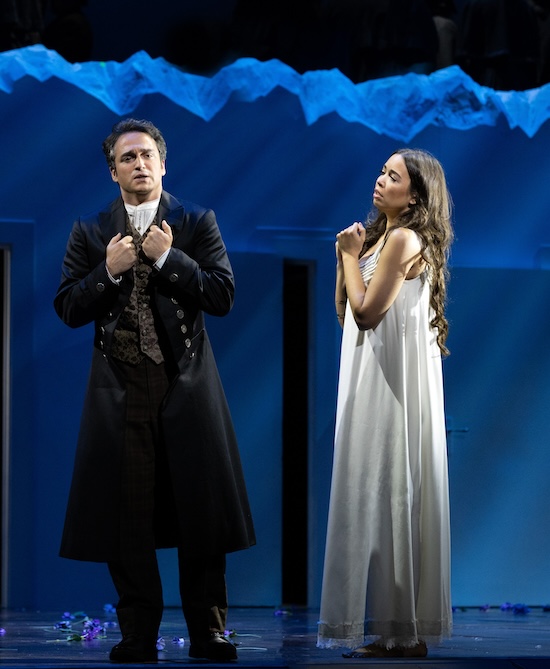
That also set Anduaga as a fine companion. There was a romantic plumminess to his sound that was welcome, and also a seriousness to his characterization. “Prendi, l’anel ti dono” seemed heavy at first, but the earnestness and rectitude that came out of it was thoughtful and effective, and made the duet “Son geloso” emotionally real.
Anduaga’s technique was also excellent, with quickness and fine intonation in the rapid turns, and a range that matched Sierra in the teasing duet. And his own style of expression was as moving as Sierra’s, the fullness of his voice making “Vedi, o madre” something that flowed smoothly and almost conversationally, without effort but full of heart. In what is a dated premise, Elvino has to express a palpable and unaffected sense of tragedy, and Anduaga nailed it.
Vinogradov delivered another terrific performance. His showpiece, “Vi ravviso, o luoghi ameni,” was relaxed, suave, and confident, but also just condescending enough for the character to feel above all the others on the social ladder (not for nothing Rodolfo enters the fray by climbing down a ladder from above). In every moment, he was both bemused by and slightly detached from the others, moving at a different pace, a winning characterization.
Mancasola was as vocally impressive as Sierra, and her “Tutto è gioia, tutto è festa” set the standard for the high quality of singing that was to come. Against her scheming and subterfuge, bass Nicholas Newton made an impressive house debut as Alessio, with a rounded, floating sound and an easy confidence to his singing. Mezzo Deborah Nansteel had terrific vocal strength and stature as Teresa, every note full of pride, perseverance, and determination, a buttress of music to protect Amina.
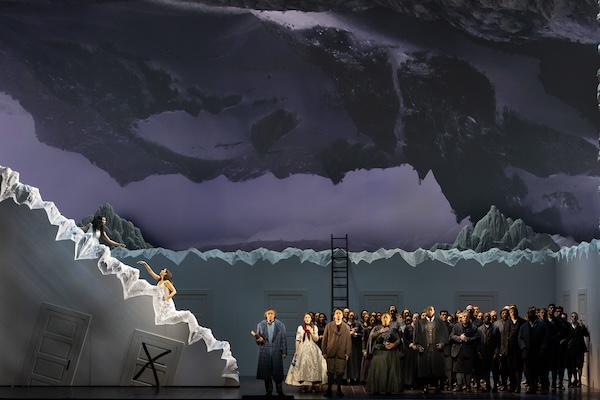
This all works exceptionally well with Villazón’s staging. He brings out the comedy by giving clear and vivid definition to the seriousness. This is not just Switzerland, but Calvinist Switzerland, the rigidity of the townsfolk pressed to the fore by the Caspar David Friedrich like Alps behind them and on the scrim. Johannes Leiacker’s set makes the stage both inn and town square, and the craggy edges and background—plus the ladder the Count uses to enter and leave—emphasize that this is an isolated, contained community. Even the chorus’ robust singing, at base a sensual pleasure, was framed in long skirts, bonnets, and suits from costume designer Brigitte Reiffenstuel.
The staging grounds the romantic mishaps in the basic conflict between fundamentalist values and worldly experience and knowledge—the Count is not only colorfully clothed but returns from the world outside bearing things like a globe and a camera, which are fascinating and confounding to the village. The threat to their equilibrium is not just adultery but knowing and seeing too much, and the Count gracefully eases them into that. And in a poetic touch that both shows the opera’s roots and makes Amina’s sleepwalking clearly different than everything else on stage, those moments have her mirrored by a dancer (the “phantom”?), Niara Hardister.
Frizza and the orchestra gave a smooth, balanced performance. There was the occasional feeling that the playing was a little too careful, and fitfully sluggish—at times threatening to drag but never doing so. It felt as if Frizza was deferring just a little too much to the singers. With Sierra and Arduaga leading the way, and the production giving them such vibrancy and purpose, that wasn’t necessarily a bad thing.
La Sonnambula runs through November 1. metopera.org